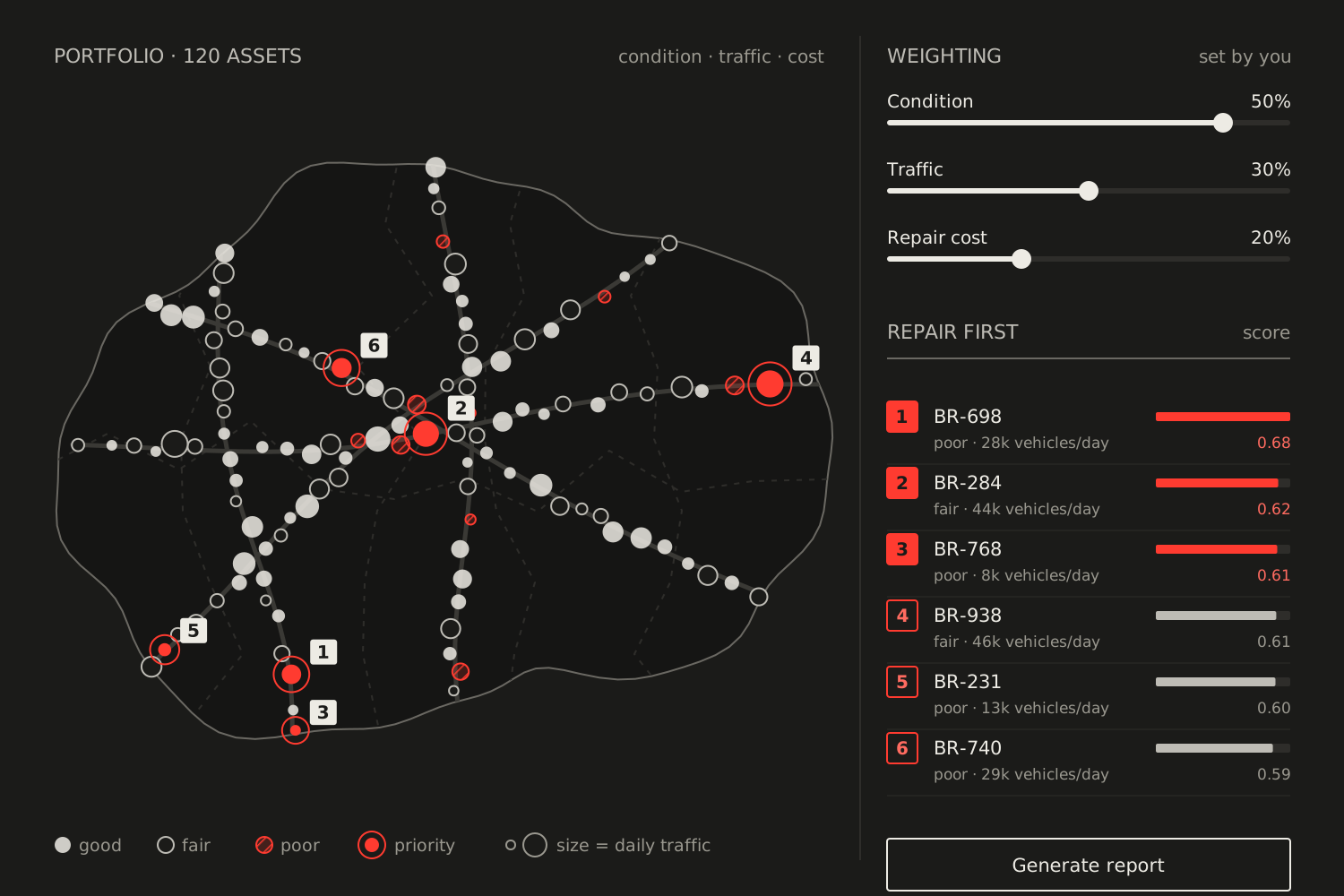
Accessible approach to data analytics fitting both small and large projects
Features
Adaptive solutions
Augmented inteligence
Optimise human operation by filtering defects from un-structured dataset.
Robust
Modular analysis provide a more reliable anlysis through fail-safe systems.
Dark data
Unused data are a missed opportunities, shining light on dark data solve this problem.
Services
Advance analytics on demand
Data
Make the most of existing data
Works with multi-format
Processing
Hybrid AI
Track changes overtime
Results
Support decision making
Flexible outputs
Science driven Team
We are a team of scientists with expertise in data-driven problem solving. From engineering to medical sciences, our strength is to be multi-disciplinary. Beyond getting value from images, we make sure of the quality of our data as well as the validity of our models.
Contact Us
Easy data collection
Facilitate data analytics from any device
In general, asset owners must deploy a specific type of instrument to monitor their civil infrastructures. These can be expensive and hard to select, but it also leads to dependencies: the owner is stuck with his brand new system.
An instrument is rarely adaptable considering the wide range of challenges facing civil infrastructure. Only from a financial point of view, not all structures are equal. It is not practical to use the same system in a systematic way.
Our algorithm is built to deal with data regardless of the source. Analysis can be provided with existing dataset and we make sure that monitoring can continue even if your equipment changes.
With our flexible approach, an inspector can either take a high resolution image for a detailed analysis, or a snap for a quick check. Local authorities and emergency services will have a cost-efficient solution to survey unexpected events such as flooding.
The data flow is adaptive to your situation. It can be basic: focusing on one defect such as crack or leakage. Changes will be detected from a series of images without the need for the perfect photo.
With a step further, images can be registered to a 3D model, providing a better analysis for the entire structure.
Spot damages in time
Image analysis can enhance visual inspection.
Bridges have many challenging factors making their monitoring difficult. They range in sizes, sometimes with ongoing traffic or inaccessible terrain, it is not always possible to record the entire structure.
In 2007, the I-35W Mississippi River bridge in Minneapolis (USA) collapsed killing 13 people. This disaster has been widely investigated from an engineering point of view with more than 2300 scientific publications.
The gusset plates were under-designed and started to bend, causing the structure to collapse. With changes in transport, traffic flow and stresses on ageing infrastructure, it is likely that many bridges can have a similar fate. Therefore it is crucial to be able to identify them before they fail.
Our custom algorithms can track defects in images by detecting irregularities in shape or colour. Then an alarm can be triggered to make an experienced surveyor aware of this issue. In this way, the inspection will be more efficient as well as being faster, especially for urgent inspection.
Flexible approach
Images just need a camera
One of the great advantage of imaging technologies is to be flexible. With the development of cameras becoming more accessible and cheaper, it is possible to use computer vision for a wide range of applications.
Images can be acquired from an IP camera, a drone or simply a phone. This offers a possibility to design custom made solutions adapted to the situation. Since our algorithms are not limited to a type of camera, the flexibility is retained to make the best out of imaging data.
For example, a structure can be fully captured in detail with a drone. Then during an inspection, a surveyor can only focus on the suspicious area to check if any change occurred.